

Hi! Remember me? If not, or if you’re new here, a little refresher: I’m Molly, your friendly neighborhood pwME (person with ME/CFS). I write about culture, life with disability, and my ongoing pursuit of meaning and joy within a life of limits. (If you’re not sure how you got here, you may have seen this piece about my Eight Year Bed-iversary, this one full of ME/CFS resources, or this one on ableism.) I’m happy you’re here!
YOU’RE INVITED!
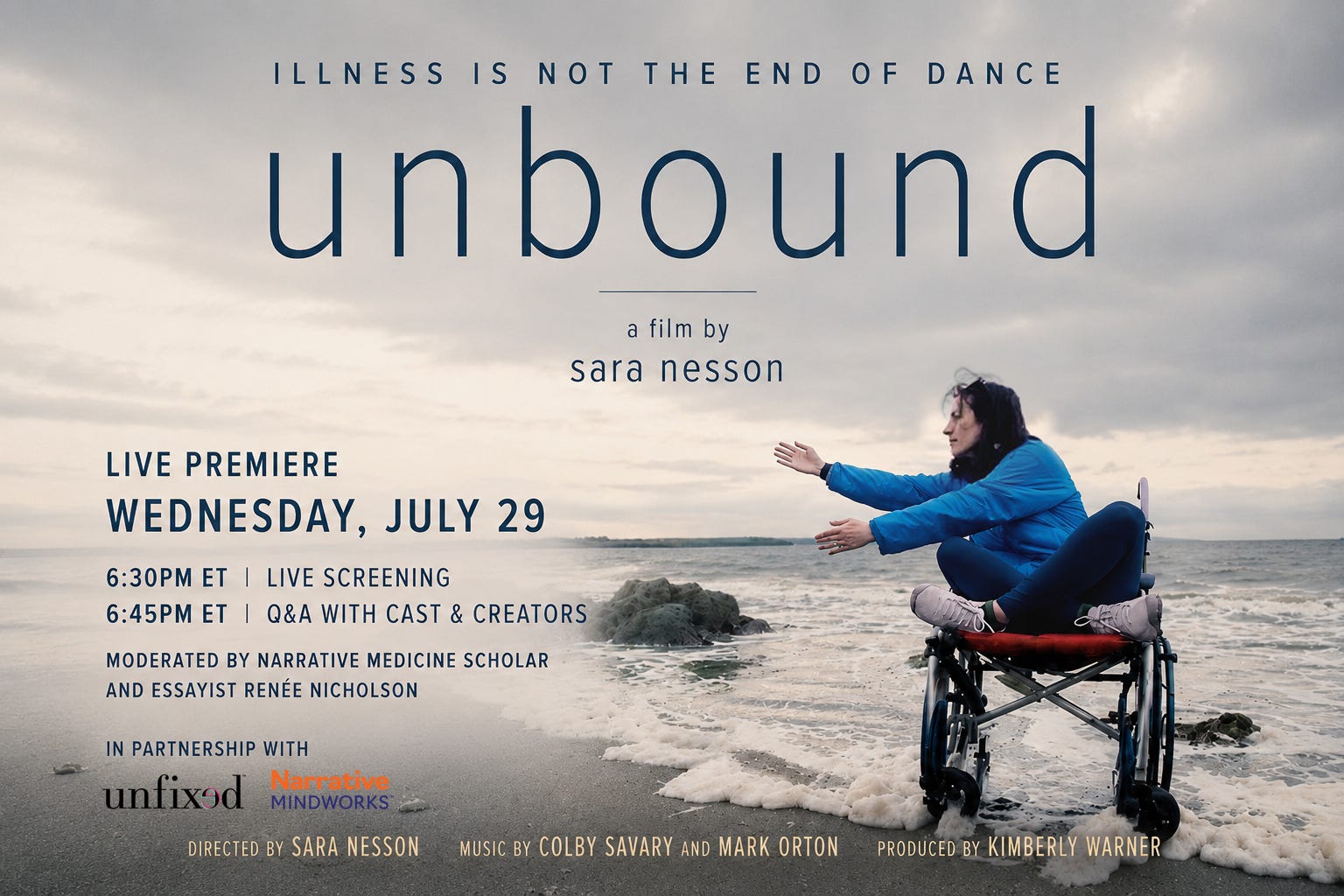
I’m in a short dance film with other people with ME/CFS and Long COVID! Join us for the free online premiere ON JULY 29 by registering below:
One of the first places I ever experienced post exertional malaise (PEM) was a dance class.
I was a freshman in college, moving my body across the hardwood floor to the live music so ubiquitous to modern dance classes it might as well have been a Portlandia sketch, when I hit a metaphorical wall.
It felt as though I had passed through a membrane, like breaking the surface of water, or maybe like stepping inside a sound wave. A couple quick pulses of something thick and slow and intense rippled through me, starting in my chest and ending in my head.
And afterwards, something was different. Was I light-headed? Dizzy? Brain foggy? Mitochondrially exhausted? Probably yes, some combo of all of the above. But I didn’t have the language for some of that, and it didn’t feel like a typical version of the rest of it. I didn’t feel like I was going to fall over or faint. I felt like suddenly my soul was three feet behind my eyes. Like my brain was wrapped in bubble wrap and cotton. Like my mouth did not belong to me and someone else was in charge of what came out of it. When I looked in the mirror, I didn’t look like myself. Something in the eyes that my boyfriend would later only be able to describe as “looking wide.”
And I didn’t feel like myself either. Where before I’d been happy, present, and confident, suddenly I felt spacey, insecure, and deeply self-conscious. I was uncomfortable in the room and in my body.
When it came time in class for us to improvise, I panicked. I couldn’t do it. Not like this.
I excused myself to the bathroom and then sat in the stall, crying, until class was over.
And that, my friends, was the beginning of the relationship between my illness and dance.
===
It would be another 20 years before I understood what was going on in those college dance classes. Before I had my diagnosis of ME/CFS and knew about pacing, about activity limits, about consequences – both immediate and delayed – for overshooting them.
Twenty years before I would understand that what was happening was that the chronic illness I’d developed a few years earlier, that kept me fatigued and foggy all the time, that necessitated naps every three hours or I felt like I had the flu, was getting worse. And had specific limits. Not just vague and random ups and downs, but predictable consequences after specific activities.
In those 20 years, I would keep dancing. All through college. Then teaching African Dance and joining a contemporary/cirque/burner dance troupe in my 20s. Then founding and joining multiple dance troupes and performance ensembles, including my beloved Richard Cheese-inspired burlesque troupe The Cheese Puffs, in my 30s.
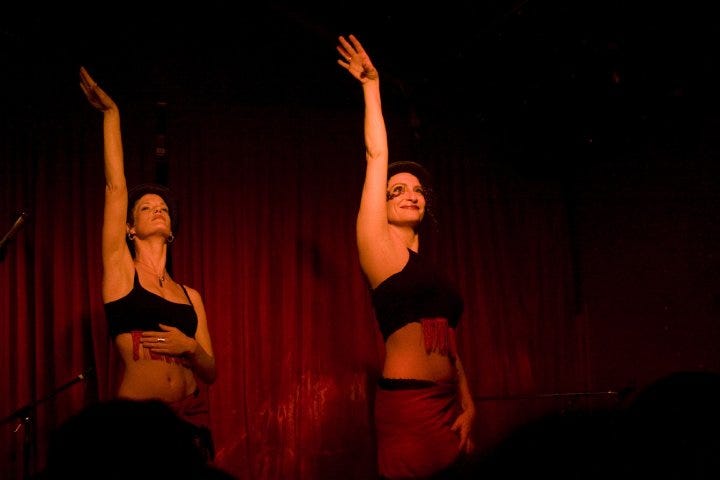


And I would occasionally take classes, noting that sometimes I was fine, but sometimes, around the 45-minute mark, which usually hit when we were going across the floor, I would get that old familiar womp-womp-womp feeling, leaving me a shell of the dancer who’d entered that room.
In my 40s, though, it all fell apart.
When my condition worsened to the point that I had to move in with my parents, that was curtains for dance classes. Curtains for dance troupes. Curtains even for doing silly little interpretive dances with my family in my living room. I was homebound and mostly bedbound, and I was now feeling that post exertional malaise feeling I’d felt in college all the time.
The consequences for physical movement were so high, I stopped using my body in any way that wasn’t 100% necessary. Forget something like bed yoga. I was so concerned with conserving spoons, if I was in the waiting room of an appointment, I would sit perfectly still with my hands in my lap so as not to waste energy crossing and uncrossing my legs.
During the dark nights of the soul of those early years, I truly thought I would never dance again.
Which was devastating.
Dance has been a profound and important part of my life and identity since I spent my entire pre-teen years dedicated to it, taking tap and ballet and jazz classes 24 hours a week, watching A Chorus Line on repeat, working at the dance studio to pay for it all. I dreamed of dancing professionally, and though that dream never materialized (well, I did get paid to dance eventually, but not in the way I imagined at 13), I still felt happiest and most at home in a room with a sprung floor and a wall full of mirrors.

In fact, after the worst and most traumatic breakup of my life, when nothing seemed to console or soothe me, the only thing that helped was running off to a ballet retreat in Morocco (and okay, yes, the Morocco part helped too lol).
Dance was home and it was help.
And then it was gone. Forever. Or so I thought.
===
I don’t remember when exactly I turned a corner.
It didn’t have to do with feeling any better.
I’m sure it had something to do with learning more about disability, disability justice, ableism, and accommodation.
It probably also had something to do with acceptance, adaptability, and starting to learn that a limited life, a disabled life, is still very much a life.
I have vague memories of conversations with my sister, maybe with a friend, about what might be possible.
All I know is that I some point, I stopped grieving the fact I could never dance again unless everything changed, and I started wondering what dance could look like if nothing ever changed. Could there still be dance in my life? Something that maybe didn’t look the same, but could operate the same?
What was the essence of dance, for me, after all?
Being present in my body. Movement. Feeling music and emotion deeply, and expressing that in a physical way.
Was there a way to engage those qualities, without standing at a barre or time stepping across a stage?
Could I move my head or my feet to a beat? Could I scrunch my mouth and blink my eyes to a melody?
If I changed my idea of what dance has to be, could I, in fact, still dance?
One night, I found myself moving my hands in the shadows of my bedroom, mesmerized by the shapes I was making on the wall and the way it felt to be using my limbs with intention.
Some time later, I found myself in my kitchen, shimmying my shoulders ever so subtly to the rhythm of a song on my headphones.
Over time, I began to let these little moments of movement, of dance, into my life whenever they showed up.
The head bobbing to the Dance Academy theme song. The air punching to the new Olivia Rodrigo album. The spontaneous stylized stretching at the dinner table as I finish a meal.
And that’s when Sara Nesson and her film “Unbound” came into my life.
Sara was making a dance film featuring those with ME/CFS and Long COVID, some with dance or movement backgrounds, many without. We could move in any way we wanted. From anywhere we wanted. We would perform short sequences of movement, each starting our phrase from where the person before us left off, and the whole piece would be strung together and set to music. It would be a conversation between us, and between us and our community, about the experience of being sick, of the pain of this illness, of finding joy despite it, of finding community. Of adapting. Of accepting. Of refusing to stop being alive even when the act of living is so fucking hard.
I wasn’t sure I had the spoons for such a project. And I still wasn’t sure what dance looked like for me. But I decided to take the leap.
Even if I had to do nothing but lay there and blink in Morse Code, I would try.
It took nearly a year for my turn to come around, and even when it did, I pushed it back several times. My symptoms kept flaring, and I didn’t want to record my part while in that womp-womp PEM state.
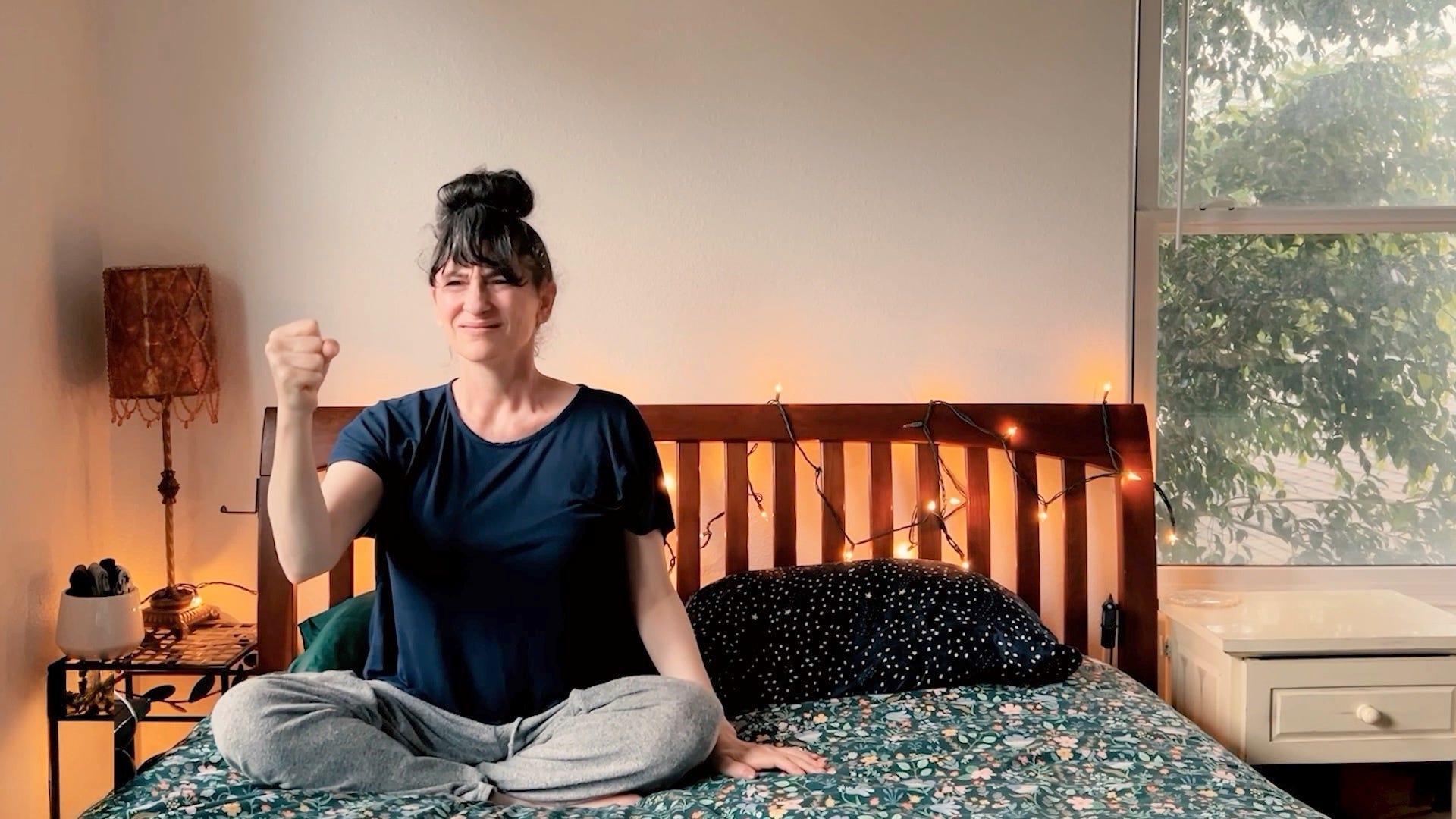
When it was finally my turn, I decided to record from the place I spend the most time: my bed. And though I have found ways to feel a lot of joy in my life, I decided to channel the pain that’s always around the corner, including the pain I feel about not being able to dance the way I wish I could.
After several back-and-forths with Sara about angles and lighting and recording techniques, I was ready to dance.
I turned on Nine Inch Nails (the song “Something I Can Never Have,” if you’re curious), and I sat cross-legged on my mattress, and I let myself feel, and then I let myself move. I tried not to think about what was pretty. I tried to think about what was true.
In the clip Sara chose, I am near tears. I can feel a heaviness in my chest, a deep sense of protest and grief, a frustration that my movement — that my life — has to be so contained when what I crave so deeply for both is freedom and expansion.
It was only a few seconds, and I mostly only moved one arm, but honestly even that was a lot for my body. Sitting upright, doing several takes, getting up and down to move the camera, and then the movement itself.
And I’m not sure how to feel about the final result. It’s hard to see myself and not critique everything about it. Not compare it to what I wish it could be. What I wish I could look like.
It’s hard to feel so very… exposed.
But what I can say is that I was fully present.
What I can say is that I was in my body.
And what I can say is that it was dance.
I danced.
I can dance.
Even now.
Even still.
Thank you for reading Well, Actually!
If you’d like to further support me or my work, please like, comment, and/or share pieces with people you think might like them too. I write the pieces I once needed - or still need - to read myself, and my greatest hope is that my work will reach other people who will feel seen, comforted, or educated by it.
And if you’d like to show support in a tangible/financial way, you can:
Upgrade to a paid subscription!
Buy me a coffee! Just a little bit of cash goes a long way. Will I use it for coffee? Probably not, since I can’t drink it. But I might just use it for a hot chocolate-flavored electrolyte drink. Or cozy socks. Or to get the fancy oat milk instead of the cheap-o kind.
Hire me! I provide developmental editing services for writers of essays (including college essays), creative nonfiction, memoir, plays and screenplays, and news/culture stories. Message me for details.
I’m grateful for any and all support, including the support you’re giving me already, just by being right here, right now. I’m truly honored and delighted you’ve chosen to share this little corner of the internet with me.
I rarely cry, but your narrative made me cry. Hello to you and all my sisters out there. I have fibromyalgia, Sjogren’s syndrome, and an unidentifiable auto immune disease that eats my cartilage. I’ve been active much of my life, often through force of will, but in my 50s things started falling apart and now that I’m 72, having had four major operations in the last 6 to 7 years. Now i can hardly get out of bed, and I’ve begun counting what each step will cost me. I mourn so much for the life I had, while trying to appreciate the life I still have. But that is being taken away from me piece by piece, too.
This is beautiful, thank you for sharing. I can't wait to watch the film. I was recently at my cousin's wedding, having a fairly good day and my siblings and family set up a chair on the edge of the dance floor for me and danced around me. It was pure joy. Not the full body movements that used to steal the show, but a full bodied experience with the people I love, adapted to LC and PEMS. Thanks for showing us another example of what's possible